
Hair Transplant in Turkey: Cost, Clinics, Risks and How to Choose Safely
Reviewed by the TransplantHair editorial team

Turkey has become one of the most searched destinations in the world for hair transplant surgery. For many international patients, the appeal is clear: experienced clinics, all-inclusive medical tourism packages, modern techniques such as FUE and DHI, and prices that are usually lower than in the United Kingdom, Germany, the United States or other Western countries. But popularity also creates confusion.
When you search for a hair transplant in Turkey, you will find hundreds of clinics, thousands of before-and-after photos, influencer videos, package deals, discount campaigns and patient testimonials. Some clinics advertise “maximum grafts.” Some promise “natural results.” Some offer hotel, airport transfer and surgery in one package. Others focus on doctor-led procedures, premium care or luxury medical tourism.
For a patient, this can be overwhelming.
The real question is not simply “Is Turkey good for hair transplants?” A better question is:
How can I compare hair transplant clinics in Turkey safely before booking?
This guide explains the main costs, techniques, clinic types, patient review patterns, red flags and questions you should consider before choosing a clinic.
Why Turkey Is So Popular for Hair Transplants
Turkey’s hair transplant market did not become popular by accident. Several factors made the country a major destination for international patients.
First, Turkey has a strong medical tourism infrastructure. Many clinics, especially in Istanbul, are used to treating patients from the UK, Germany, the Netherlands, Scandinavia, the Middle East and North America. Because of this, many providers offer services such as airport transfers, hotel accommodation, translators, post-operative instructions and remote follow-up.
Second, the cost of treatment is usually lower than in many Western countries. A patient who might pay a high per-graft price in the US, UK or Germany may find a package-based offer in Turkey that includes surgery, accommodation and transfers.
Third, Turkey has a large number of clinics competing in the same space. This gives patients more choice, but it also makes comparison harder. Not every clinic has the same level of medical involvement, transparency, aftercare or patient communication.
This is why patients should not choose a clinic only because it appears first on Google, has a large Instagram following, or offers the cheapest package.
A hair transplant is a medical procedure. It should be researched carefully.
How Much Does a Hair Transplant in Turkey Cost?
Hair transplant prices in Turkey vary widely. Many clinics use package pricing instead of strict per-graft pricing. This means the patient may receive one total price for the procedure, hotel, transfers and basic aftercare.
In general, many international patients see package prices somewhere between $1,500 and $6,000, depending on the clinic, technique, graft number, doctor involvement and what is included. Some lower-cost offers may be available, while premium or doctor-led procedures can cost more.
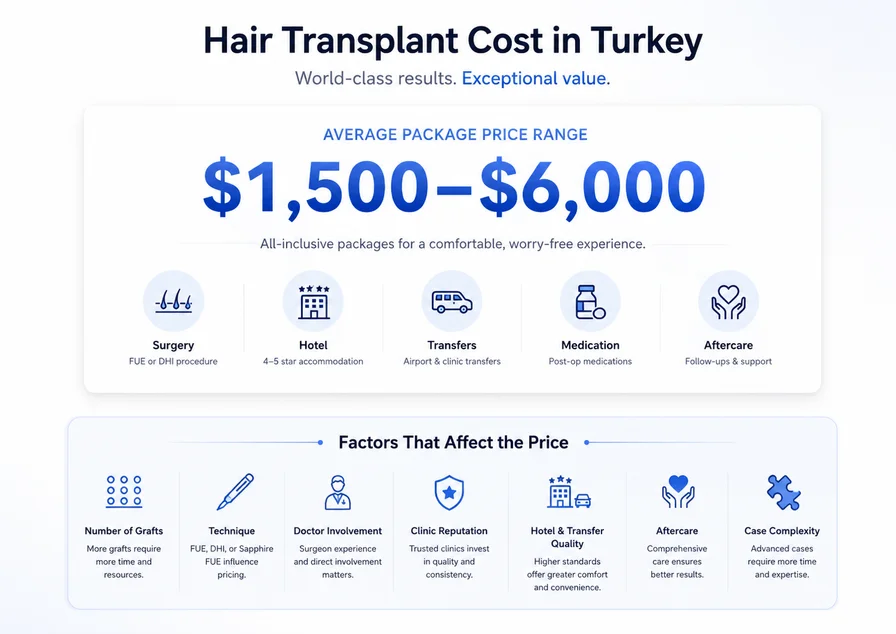
A typical hair transplant package in Turkey may include:
Initial consultation
Hairline planning
Blood tests
Local anesthesia
FUE, DHI or Sapphire FUE procedure
PRP treatment in some packages
Hotel accommodation
Airport transfers
Clinic transfers
Medication and shampoo kit
First wash
Post-operative instructions
Remote aftercare support
However, not all packages are equal.
Two clinics may both advertise a $3,000 package, but the actual experience can be completely different. One may include direct doctor involvement, detailed planning and strong aftercare. Another may rely heavily on technicians, treat many patients per day and provide limited follow-up.
Before comparing prices, compare what is actually included.
What Affects the Final Price?
Several factors can change the cost of a hair transplant in Turkey.
1. Number of grafts
A patient who needs 2,000 grafts for hairline restoration is not the same as a patient who needs 4,500 grafts for frontal and crown coverage. More grafts usually require more time, more staff involvement and more careful donor management.
However, more grafts are not always better. A clinic should explain how many grafts are realistic for your donor area. Overharvesting can damage the donor area permanently.
2. Technique used
FUE, DHI and Sapphire FUE may have different prices depending on the clinic. Some clinics charge more for DHI because it can require more time and specialized tools. Others include multiple techniques in one package.
The best technique depends on the patient’s hair loss pattern, donor area, hair type and goals.
3. Doctor involvement
This is one of the most important price factors. In some clinics, the doctor may design the hairline and supervise the operation. In others, the doctor may perform key surgical steps. In technician-led clinics, the medical team may perform most of the procedure.
Patients should ask exactly who performs each step.
4. Clinic reputation
Well-known clinics with strong international visibility may charge more. However, reputation alone is not enough. Patients should still check real case examples, communication quality and aftercare.
5. Hotel and transfer quality
Some packages include basic accommodation, while others include premium hotels and private transfers. This can affect the total cost.
6. Aftercare
Good aftercare matters. Hair transplant results develop over many months. Patients should know whether the clinic provides follow-up support after they return home.
FUE, DHI and Sapphire FUE: What Do They Mean?
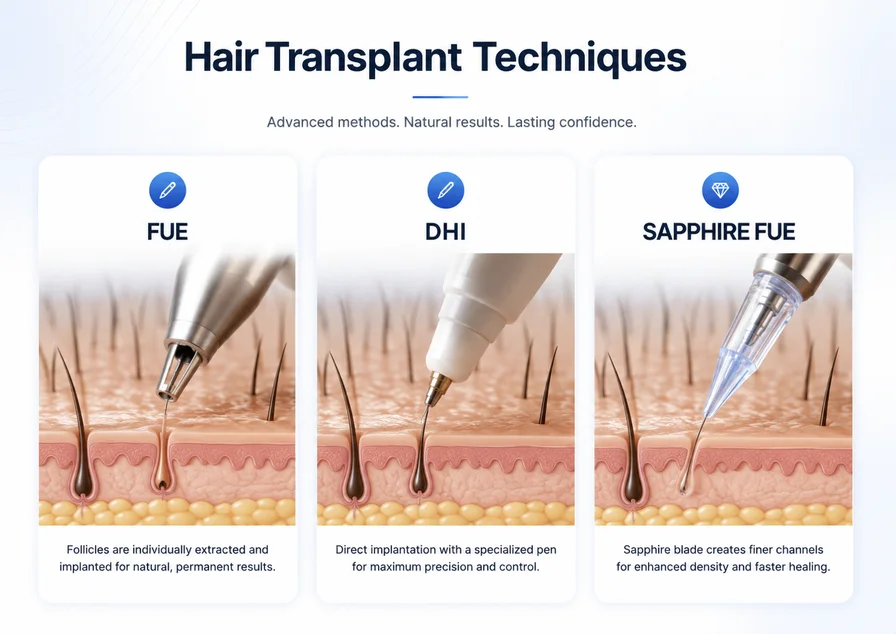
Most patients researching hair transplants in Turkey will see three common terms: FUE, DHI and Sapphire FUE.
FUE Hair Transplant
FUE stands for Follicular Unit Extraction. In this method, individual hair follicles are extracted from the donor area, usually the back and sides of the scalp. These grafts are then implanted into the recipient area.
FUE is widely used and can produce natural-looking results when the planning, extraction and implantation are done carefully.
The quality of FUE depends on:
Donor area evaluation
Hairline design
Graft survival
Implantation angle
Density planning
Medical team experience
Post-operative care
FUE is not automatically good or bad. The result depends on the clinic and the case planning.
DHI Hair Transplant
DHI stands for Direct Hair Implantation. In DHI, grafts are placed using an implanter pen. Some clinics market DHI as a more advanced method, especially for density and hairline work.
DHI may be suitable for some patients, but it is not automatically better for everyone. It still depends on the skill of the team, graft handling and realistic planning.
Patients should be careful when a clinic presents one technique as “the best” for every case. A serious clinic should explain why a certain method fits your hair loss pattern.
Sapphire FUE
Sapphire FUE is a variation of FUE where sapphire blades are used to create channels in the recipient area. Clinics often describe this as more precise or more modern.
However, patients should remember that a tool alone does not guarantee a natural result. A natural-looking hair transplant depends on angle, density, hairline design and donor preservation.
The question is not only “Do you use Sapphire FUE?”
The better question is:
Who performs the channel opening, and how is the hairline planned?
The Most Important Question: Who Performs the Surgery?
Doctor involvement is one of the most important issues in Turkish hair transplant clinics.
Some clinics are doctor-led. Some are doctor-supervised. Some are mostly technician-led. This does not automatically mean one clinic is always good and another is always bad. Experienced technicians can be highly skilled, and many hair transplant teams work with trained staff.
But the patient should know exactly what is happening.
Before booking, ask:
Who will design my hairline?
Who will extract the grafts?
Who will open the channels?
Who will implant the grafts?
Will the doctor be present during the operation?
How many patients does the clinic treat per day?
Will one team stay with me throughout the procedure?
What happens if I am not satisfied with the result?
If the clinic avoids these questions or gives vague answers, you should be careful.
A transparent clinic should be able to explain the process clearly.
How to Read Patient Reviews Without Being Misled
Patient reviews can be helpful, but they should not be read blindly.
A five-star review does not always mean the result is good. Sometimes patients leave reviews immediately after surgery, before the final result has appeared. Hair transplant results usually take many months to develop, so a review written after two days may tell you more about the hotel, transfers and staff friendliness than the actual hair result.
Useful patient reviews usually include details such as:
Hair loss level
Number of grafts
Technique used
Clinic name
Doctor or team involvement
Recovery experience
Photos after 6–12 months
Donor area condition
Whether the patient felt rushed
How the clinic handled aftercare
Short reviews like “great clinic, amazing result” are less useful unless they include case details.
When reading public reviews, look for patterns. One negative review does not always mean a clinic is bad. One positive review does not prove that a clinic is excellent. The important thing is whether the same themes appear repeatedly.
Common Positive Themes in Patient Reviews
Across public hair transplant discussions and review platforms, positive reviews often mention practical parts of the experience, not only the final result.
Patients commonly praise:
Smooth airport pickup
Friendly staff
English-speaking coordinators
Clean clinic environment
Clear washing instructions
Good hotel organization
Natural-looking hairline
Easy WhatsApp communication
Confidence improvement after growth starts
Helpful post-operative support
These details matter because many international patients are nervous about traveling abroad for surgery. A well-organized clinic experience can reduce stress.
However, comfort and organization should not replace medical quality. A luxury hotel does not guarantee a good hairline. Friendly communication does not guarantee safe donor management.
Common Concerns in Patient Reviews
Patient concerns often focus on issues such as:
Feeling rushed during consultation
Limited direct contact with the doctor
Waiting times at the clinic
Unclear explanation of who performs the procedure
Different expectations about density
Shock loss or slow growth anxiety
Donor area concerns
Difficulty reaching the clinic months later
Confusion about what is included in the package
Pressure to pay a deposit quickly
Some of these concerns may be normal parts of the process, while others may reveal real weaknesses in the clinic’s communication or planning.
For example, slow growth at three months is often normal. But not knowing who performed the surgery is a preventable transparency issue.
Before-and-After Photos: What to Check
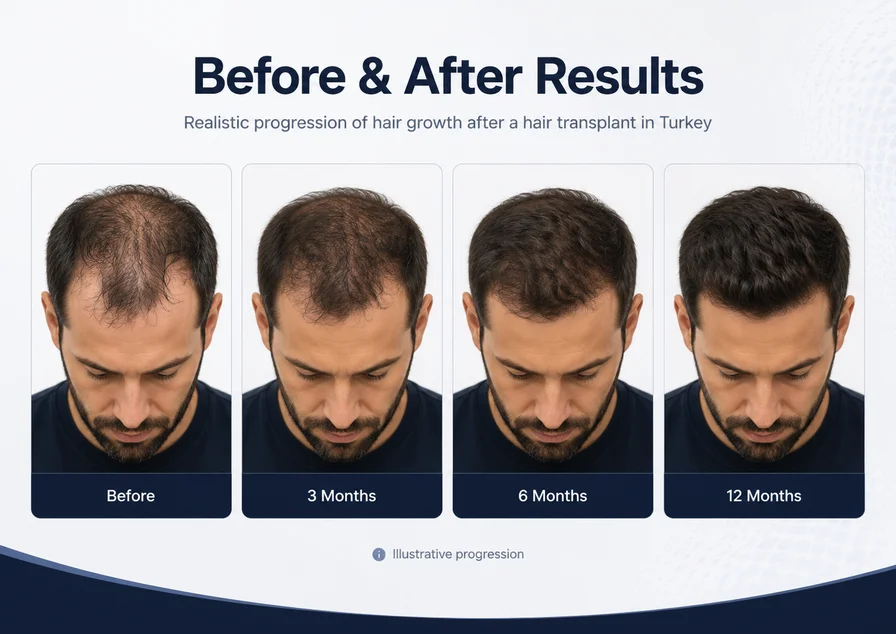
Before-and-after photos are one of the strongest marketing tools in hair transplantation. But they can also be misleading.
When checking photos, ask:
Are the lighting and angles similar?
Is the hair length similar?
Is the result shown after 9–12 months?
Can you see the hairline clearly?
Can you see the donor area?
Is the hair combed forward to create the appearance of density?
Are there close-up photos?
Are there cases similar to your hair type?
Does the clinic show realistic results or only perfect cases?
A good before-and-after gallery should show variety. Not every patient has the same donor area, hair thickness, age or hair loss pattern.
If every photo looks too perfect, with no close-ups and no donor area images, you should ask for more realistic examples.
Red Flags Before Booking a Hair Transplant in Turkey
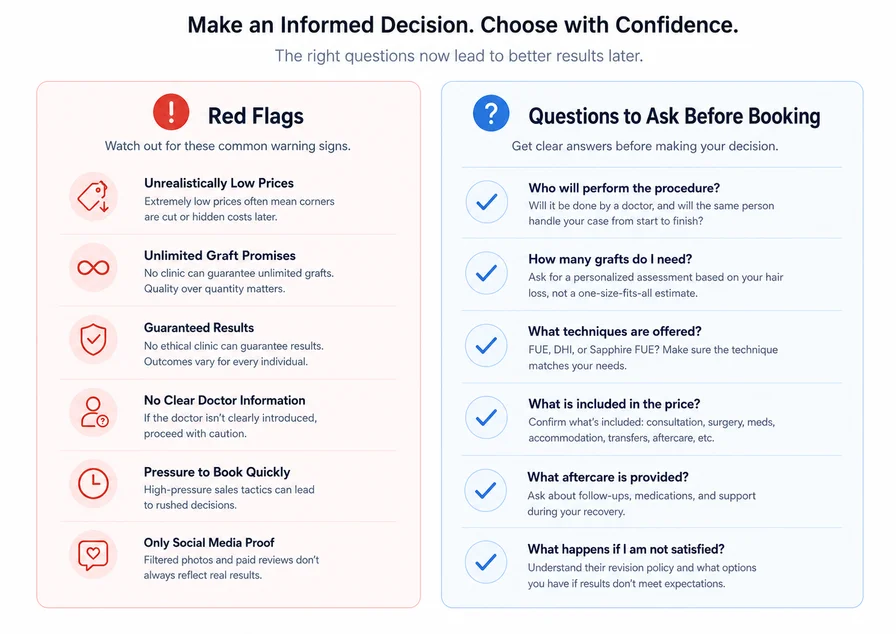
Turkey has many experienced clinics, but the market is also highly competitive. Patients should watch out for red flags.
1. Unrealistically cheap packages
Low prices are one reason people choose Turkey, but extremely cheap offers should be checked carefully. If the price is far below the market, ask what is missing.
Questions to ask:
Is the clinic licensed?
Who performs the operation?
Is the doctor involved?
How many patients are treated per day?
Are medications included?
Is aftercare included?
Are there hidden costs?
A cheap package can become expensive if the result requires repair surgery later.
2. “Unlimited grafts” without explanation
Some clinics advertise unlimited grafts. This can sound attractive, but donor hair is limited. A responsible clinic should not simply take as many grafts as possible. It should protect the donor area for the long term.
Ask why the recommended graft number is suitable for your case.
3. Guaranteed results
No clinic can honestly guarantee a perfect result for every patient. Hair growth depends on many factors, including donor quality, healing, age, future hair loss, medical history and aftercare.
A clinic can have confidence in its work, but absolute guarantees should be treated carefully.
4. No clear doctor information
If you cannot understand who the doctor is, what their role is, or who performs the main steps of the procedure, ask before paying.
5. Pressure to book quickly
Medical decisions should not feel like a flash sale. Be careful if a clinic pushes you to pay a deposit immediately without answering your questions.
6. No discussion of future hair loss
A hair transplant moves existing hair. It does not stop future hair loss. A serious consultation should consider your age, family history and long-term plan.
7. Only social media proof
Instagram and TikTok can help you discover clinics, but they should not be your only source. Look for detailed patient experiences, long-term results, clinic transparency and independent discussions.
What Should a Good Hair Transplant Package Include?
Before choosing a clinic, ask for a written explanation of the package.
A good package should clearly explain:
Consultation process
Recommended graft number
Technique
Doctor involvement
Hotel details
Airport transfer details
Clinic transfer details
Blood tests
Medication
Washing instructions
Follow-up process
Aftercare contact
Extra costs
Payment terms
Cancellation policy
If a clinic only says “everything included,” ask them to list what “everything” means.
Is Turkey Safe for Hair Transplants?
Turkey can be a safe and effective destination for hair transplants when patients choose carefully. Many clinics treat international patients every day and have extensive experience.
However, safety depends on the clinic, the medical team, the process and the patient’s own health condition.
A hair transplant is still a surgical procedure. It involves local anesthesia, graft extraction, implantation, wound healing and infection control. Even if the procedure is common, it should be taken seriously.
Before traveling, patients should consider:
Medical history
Allergies
Current medications
Blood pressure
Previous surgeries
Smoking
Scalp condition
Realistic expectations
If you have a medical condition, discuss it with a qualified physician before booking.
Who Is a Good Candidate?
A good hair transplant candidate usually has:
Sufficient donor hair
Realistic expectations
Stable or understood hair loss pattern
Good general health
Clear goals
Willingness to follow aftercare instructions
Understanding that final results take time
Younger patients should be especially careful. If hair loss is still progressing quickly, a poorly planned transplant may look unnatural later.
A good clinic should not only ask “How many grafts do you want?” It should evaluate whether a transplant is the right decision at this stage.
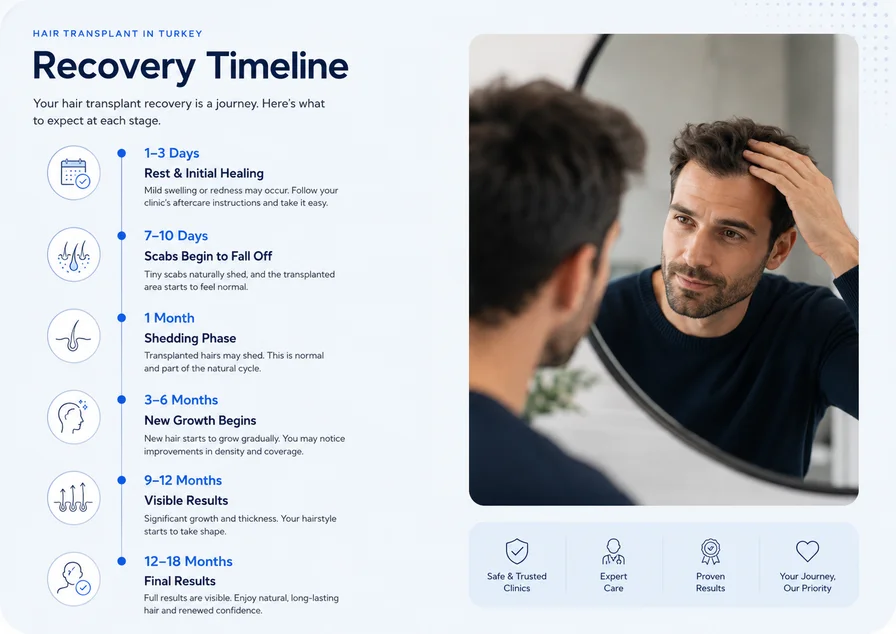
Hair Transplant Recovery Timeline
Recovery is one of the most misunderstood parts of hair transplantation.
First 1–3 days
The scalp may feel sensitive. Swelling, redness and mild discomfort can occur. Patients usually rest and follow clinic instructions carefully.
First 7–10 days
Scabs begin to clear. Some clinics perform the first wash, while others provide detailed washing instructions.
First month
Transplanted hairs may shed. This is common and does not necessarily mean the transplant failed.
3–6 months
Early growth may begin. Density is usually still limited, and many patients feel impatient during this stage.
6–9 months
Visible improvement usually becomes clearer. Hair texture may still be changing.
9–12 months
Most patients see a more developed result during this period.
12–18 months
Final results may continue to improve, especially in crown cases.
Patients should avoid judging the final result too early. A review written after one week is not the same as a review written after one year.
How to Compare Clinics in Turkey
Instead of asking “What is the best hair transplant clinic in Turkey?”, ask “Which clinic is best for my case?”
Different patients need different things.
A patient who needs a soft, natural hairline may prioritize hairline design. A patient with advanced hair loss may need careful donor management. A patient with curly or Afro-textured hair may need a team experienced with that hair type. A patient who wants maximum doctor involvement may choose differently from someone focused on package price.
Compare clinics by:
Doctor involvement
Case similarity
Technique options
Graft planning
Donor management
Before-and-after quality
Patient review patterns
Aftercare support
Price transparency
Communication quality
Number of patients per day
Long-term planning
A good clinic comparison should help you ask better questions, not simply choose the most famous name.
Questions to Ask Before Booking
Before paying a deposit, ask the clinic these questions:
How many grafts do I need and why?
Which technique do you recommend for my case?
Who will design my hairline?
Who will extract the grafts?
Who will open the channels?
Who will implant the grafts?
Will the doctor be present during the procedure?
How many patients do you treat per day?
Can I see cases similar to mine?
Can I see donor area photos after healing?
What is included in the package?
Are there any extra costs?
What happens if my donor area is weak?
What aftercare do you provide after I return home?
What is your policy if I am unhappy with the result?
If the clinic answers clearly, that is a positive sign. If the answers are vague, rushed or overly sales-focused, be careful.
Should You Choose the Cheapest Clinic?
Price matters, but it should not be the only factor.
A very cheap hair transplant can be tempting, especially when travel, hotel and surgery are included. But poor planning, overharvesting or unnatural hairline design can create long-term problems.
Repair surgery is often more difficult than a first transplant. Donor hair is limited. Once it is used badly, it cannot always be replaced.
A better approach is to compare value:
Is the price clear?
Is the medical team clear?
Is the technique suitable?
Is the donor area protected?
Is the hairline natural?
Is aftercare available?
Are patient results realistic?
The best clinic is not always the most expensive. But the cheapest offer should be questioned carefully.
How TransplantHair Helps You Compare

TransplantHair is designed to help patients compare hair transplant clinics in Turkey more clearly before making a decision.
Instead of relying only on advertisements, social media posts or one clinic’s sales team, patients can use comparison pages, clinic profiles, cost information and practical checklists to understand their options.
The goal is not to tell every patient to choose the same clinic. The goal is to help patients compare clinics based on the factors that actually matter:
Cost
Technique
Location
Doctor involvement
Package details
Review patterns
Before-and-after quality
Aftercare
Transparency
A better comparison process leads to better questions. Better questions lead to safer decisions.
Sources and Review Methodology
This guide is based on publicly available clinic information, patient-facing package descriptions, medical tourism resources, clinic websites and common patient discussion themes from public review platforms and hair transplant communities.
We do not copy patient reviews directly. Instead, we summarize recurring patterns such as pricing transparency, doctor involvement, communication quality, aftercare, waiting times and patient concerns.
Sources that patients commonly check include clinic websites, Google Business Profile reviews, Trustpilot pages, RealSelf discussions, Reddit hair transplant communities and public before-and-after galleries.
Individual experiences may vary. A patient review is not medical evidence, and this guide does not replace a consultation with a qualified physician.
Final Thoughts
Turkey can be a strong option for hair transplant surgery, but patients should not choose blindly.
The safest decision is not based only on the cheapest price, the most famous clinic, the biggest Instagram page or the most impressive before-and-after photo. A safer decision comes from comparing clinics carefully, asking direct questions and understanding your own case.
Before booking a hair transplant in Turkey, compare the cost, technique, doctor involvement, patient review patterns, before-and-after photos and aftercare process.
A hair transplant is not only about adding hair. It is about creating a natural, safe and long-term result.