
Turkey vs Poland Hair Transplant: Cost, Clinics and EU Value Compared
Reviewed by the TransplantHair editorial team
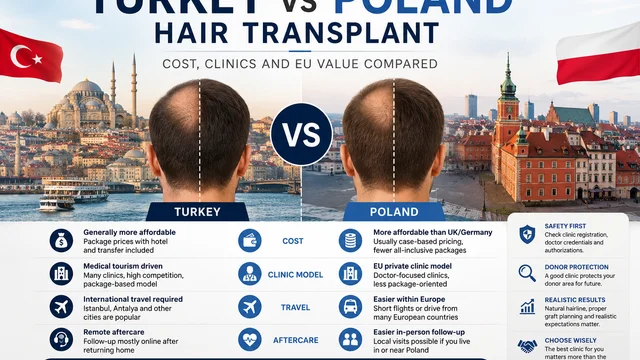
Compare hair transplant in Turkey vs Poland by cost, clinic model, travel, aftercare, safety checks and clinic examples. Learn when Turkey makes sense, when Poland may be better, and what European patients should verify before choosing FUE or DHI surgery.
Turkey vs Poland Hair Transplant: Cost, Clinics and EU Value Compared
For European patients comparing hair transplant options abroad, Poland and Turkey can both look attractive, but for different reasons.
Poland is an EU-based option with private clinics in cities such as Warsaw, Poznań, Katowice and Kraków. It can be cheaper than the UK, Germany or some Western European clinics, while still keeping patients inside Europe. Turkey, on the other hand, has a much larger international hair transplant market, more package-based pricing and a stronger medical tourism setup for patients travelling from abroad.
The decision is not simply “Turkey is cheaper” or “Poland is safer because it is in the EU”. The right choice depends on your graft needs, donor area, budget, travel comfort, aftercare expectations and how carefully you compare clinics.
This guide compares Turkey vs Poland for hair transplant surgery across cost, clinic models, travel, aftercare, safety checks and clinic examples.
Quick comparison: Turkey vs Poland hair transplant
Cost: Turkey is usually cheaper for international patients because many clinics use package pricing that may include hotel, transfers and post-op support. Poland is often cheaper than the UK or Germany, but may not be as package-driven as Turkey.
Clinic model: Turkey has a larger medical tourism model, especially in Istanbul, Antalya, Ankara and Izmir. Poland is more EU private-clinic focused, with many patients comparing specific doctors or clinics rather than all-inclusive tourism packages.
Travel: Turkey requires travel outside the EU for European patients, while Poland may be easier for patients who want to stay inside the EU or travel by short flight, train or car from nearby countries.
Aftercare: Poland can be stronger for in-person follow-up if the patient lives nearby or can return easily. Turkey clinics often provide remote aftercare after the patient returns home.
Clinic choice: Turkey has a larger international hair transplant market and more clinic package competition. Poland has a smaller market, but patients may find specialist clinics in Warsaw, Poznań, Katowice and other major cities.
Best for Turkey: Patients who want lower package prices, many clinic options and international patient infrastructure.
Best for Poland: European patients who want an EU-based option, shorter travel from Central Europe and potentially lower prices than Western Europe.
Main caution: In both countries, patients should avoid choosing only by price. Donor planning, doctor involvement, graft estimate, aftercare and clinic transparency matter more than the country name.
Why patients compare Poland and Turkey
Poland sits in an interesting middle position.
For many European patients, Poland feels more accessible than Turkey because it is inside the EU and can be reached easily from Germany, Czechia, Slovakia, the Nordics and the Baltics. It may also feel more familiar for patients who prefer EU-based private healthcare.
Turkey is usually compared for a different reason: value and scale. Turkish clinics often offer full packages with hotel, transfers, interpreter support and post-op care. For patients coming from the UK, Germany, Scandinavia, the Netherlands or Poland itself, Turkey can look more affordable and easier to organise.
Poland may be attractive if you want an EU-based procedure and easier return visits. Turkey may be attractive if you want a broader clinic market, more package competition and lower advertised prices.
The real question is not which country sounds better. The real question is:
Which clinic gives me a realistic graft plan, protects my donor area, explains who performs each surgical step and supports me after surgery?
Hair transplant cost in Poland
Poland is usually less expensive than the UK, Germany or the United States, but it is not always as cheap as Turkey.
Published marketplace data from Bookimed lists Poland FUE hair transplant procedures around $2,400–$6,400, with DHI around $3,500–$5,500, depending on clinic, graft count and technique. (Bookimed)
Another 2025–2026 cost comparison estimates Poland around €3,500–€7,000 for 2,000–4,000 grafts, with higher prices possible in major cities such as Warsaw or Kraków. That same source notes that all-inclusive lodging and transfer packages are less common in Poland than in Turkey. (Dr Serkan Aygin Clinic)
Common Poland cost factors
A Poland hair transplant quote can change based on:
Warsaw, Poznań, Katowice, Kraków or regional clinic location
FUE, DHI, FUT or robotic-assisted method
graft number
surgeon involvement
whether the case includes the crown
whether it is a repair procedure
clinic reputation
local follow-up structure
PRP or mesotherapy add-ons
whether accommodation or transfers are included
What this means for patients
Poland can be good value if you want a European clinic and do not want to pay UK or German private prices. But patients should still compare the full medical plan.
A lower Poland quote is only useful if the clinic clearly explains graft numbers, donor area limits, who performs the procedure and what aftercare is included.
Hair transplant cost in Turkey
Turkey is usually cheaper than Poland for package-based international treatment, especially when hotel and transfers are included.
On TransplantHair, Turkey package prices can be compared by city. Current listed ranges include Istanbul, Antalya, Ankara and Izmir, with each destination showing the lowest and highest listed clinic package in that city. The cost calculator also explains that ranges update as clinics add or change package prices. (transplanthair.co)
Many Turkey hair transplant packages may include:
online consultation
graft estimate
blood test
surgery
local anaesthesia
hotel stay
airport transfer
clinic transfer
translator support
post-op medication kit
first wash
remote follow-up
But not every package includes the same things. Some clinics may include hotel and transfers, while others may charge extra for certain services or upgrades.
What to ask about Turkey pricing
Before booking a Turkey clinic, ask:
Is the price fixed or can it change after arrival?
How many grafts are included?
Is there a safe medical limit on grafts?
Is hotel included?
How many hotel nights are included?
Are airport transfers included?
Are medications included?
Is PRP included or extra?
Who performs extraction?
Who opens the channels?
What happens if fewer grafts are medically safe?
Turkey’s official HealthTürkiye platform says the Ministry of Health has rules for authorising healthcare facilities and intermediaries serving international patients, and Turkey’s Health Tourism Department also publishes lists of authorised healthcare providers. (Sağlık Türkiye)
Poland private clinics vs Turkey package clinics
Turkey and Poland often feel like two different clinic models.
Poland clinic model
A typical Poland hair transplant journey may look like this:
Online or in-person consultation
Hair loss diagnosis
Donor area assessment
Quote based on graft number or case complexity
Surgery appointment
In-person follow-up if the patient can return
Long-term review and medication planning
Poland may feel more like a private European medical service than a full medical tourism package. That can be good for patients who want a more doctor-focused process and do not need hotel-transfer support.
Turkey clinic model
A typical Turkey hair transplant journey may look like this:
Online photo consultation
Graft estimate
Package quote
Flight booking
Airport transfer
Hotel check-in
Consultation, blood test and hairline design
Surgery day
First wash or post-op check
Return home
Remote follow-up
Turkey can be more convenient for international patients because the logistics are often organised by the clinic. But convenience should not replace medical checks.
Patients should still ask who is responsible for the surgery, how many patients are treated per day, and whether the donor area is being protected.
Safety and regulation: what patients should check
Hair transplantation is a surgical procedure. It may be performed under local anaesthesia, but it still involves graft extraction, recipient site creation, wound healing, infection control and donor area planning.
In Poland, patients can check healthcare entities through the Register of Entities Performing Medical Activities, known as RPWDL. Poland’s Ministry of Health says this register contains data about entities providing healthcare services in Poland, including contact information and the scope of services. (Gov.pl)
The Polish e-Health Centre also describes RPWDL as an electronic register maintained under the Act on Medical Activity, with public information about medical entities and professional practices. (ezdrowie.gov.pl)
For Turkey, patients should check whether the provider is authorised for international health tourism through official Turkish health tourism resources. (Sağlık Türkiye)
Essential safety questions
Before choosing a clinic in either country, ask:
Is the clinic registered or authorised?
Who is the doctor responsible for my case?
Will I meet the doctor before surgery?
Who performs graft extraction?
Who opens the recipient channels?
Who implants the grafts?
How many patients does the team operate on per day?
What happens if my donor area is weak?
What is the plan for future hair loss?
What aftercare is included?
Can I see similar cases with graft count and timeline?
What complications are possible?
A serious clinic should be able to answer these clearly.
Travel from Poland to Turkey
For Polish patients, Turkey is a practical medical travel destination. Flights from Warsaw, Kraków, Katowice, Gdańsk or other Polish cities to Istanbul or Antalya can make a short medical trip possible.
Polish citizens were granted visa exemption for touristic visits and transit to Turkey for up to 90 days in every 180 days, according to Turkey’s Directorate of Communications. (İletişim Başkanlığı) The Turkish Ministry of Foreign Affairs also advises foreigners entering Turkey to have a passport or travel document valid for at least six months from arrival. (Dışişleri Bakanlığı)
A typical Poland-to-Turkey hair transplant trip may take 3–5 days:
Day 1: Flight, airport transfer, hotel check-in
Day 2: Consultation, blood test, hairline design and surgery
Day 3: Rest or first wash
Day 4: Post-op check and return flight
Day 5+: Recovery at home
Patients should not treat the trip like a normal holiday. After surgery, grafts need protection. Swimming, alcohol, heavy exercise, strong sun exposure and tight hats are usually restricted in the early healing period.
Recovery timeline: same biology, different follow-up
The recovery biology is the same whether surgery happens in Poland or Turkey.
The NHS gives a general hair transplant recovery timeline: bandages may usually be removed after 2–5 days, gentle washing may be possible around day 6, transplanted hair often falls out after a few weeks, new hair usually starts to appear around 4 months, and full results may take 10 to 18 months. (nhs.uk)
This means patients should not judge the final result too early. Redness, scabbing and shedding can be part of the normal process. The real result develops slowly.
The difference is follow-up access.
If you have surgery in Poland and live nearby, returning for a check-up may be easier. If you travel to Turkey, follow-up may be remote after you return home. Remote aftercare can work well if the clinic is responsive, but it needs to be clear before surgery.
Ask the clinic:
Who reviews my post-op photos?
How often should I send updates?
Can I speak with medical staff after returning home?
What symptoms require urgent local care?
What happens if growth is poor after 12 months?
Is the revision policy explained in writing?
Aftercare: Poland’s main advantage for nearby European patients
Poland’s biggest advantage is often not price. It is location.
If you live in Poland, Germany, Czechia, Slovakia, Lithuania or another nearby country, a Polish clinic may be easier to revisit than a clinic in Turkey. That matters if you want in-person consultation, donor checks, post-op washing or long-term review.
Turkey clinics may provide remote support through WhatsApp, email or patient portals. Some do this very well. But remote follow-up is not the same as visiting the clinic in person.
Poland may be better if:
you live nearby
you want easier return visits
you prefer EU-based private care
you want local or regional accountability
you are anxious about travelling outside Europe
Turkey may be better if:
you want lower package pricing
you want hotel and transfer support
you want a larger clinic market to compare
you are comfortable with remote follow-up
you want more package competition
Polish hair transplant clinic examples patients often research
The following Polish clinics are included only as research examples. They are not ranked, verified or endorsed by TransplantHair.
Klinika Kolasiński, Poznań
Klinika Kolasiński describes itself as a private clinic specialising in plastic surgery and hair restoration surgery. Its website says the clinic was established in 1984 and includes hair transplantation among its services. (Klinika Kolasiński)
Dr Turowski Hair Restoration Clinic, Katowice and Warsaw
Dr Turowski Hair Restoration Clinic states that its team carried out the first FUE ARTAS hair transplant operation in Poland and Central-Eastern Europe, and says it currently performs more than 400 procedures annually. (DrTurowski.pl)
Dr Piotr Turkowski / PT Clinic, Warsaw
PT Clinic describes Dr Piotr Turkowski as a specialist performing hair transplantation in Poland, with the clinic stating that he and his team perform up to 170 hair transplants per year. (PT Klinik)
Kierach Medical Clinic, Warsaw
Kierach Medical Clinic states that Dr Artur Kierach gained experience in minimally invasive FUE-DHI hair transplantation with specialists in different countries and provides information about hair transplant doctors in Warsaw. (Kierach Medical Clinic)
FullFace Clinic, Warsaw
FullFace Clinic says it performs hair transplants in Warsaw using manual FUE and DHI techniques and describes a doctor-patient model where the doctor participates from qualification through graft collection, implantation and post-procedure care. (FullFace)
Again, these are research examples, not recommendations. Patients should verify registration, doctor credentials, case photos, pricing, surgical responsibility and aftercare before choosing any clinic.
Turkey clinic types Polish and European patients usually compare
Turkey has a larger and more international hair transplant market than Poland. Instead of searching for one universal “best clinic”, patients should understand clinic types.
1. High-volume package clinics
These clinics often treat many international patients and compete on package pricing. They may include hotel, transfers and translator support. The key questions are how many patients are treated per day and who performs each surgical step.
2. Surgeon-led premium clinics
These clinics usually position themselves around doctor involvement, careful donor management, hairline planning and more selective patient intake. Prices may be higher, but the process may be more personalised.
3. Technique-focused clinics
Some clinics market DHI, Sapphire FUE, unshaven FUE, beard transplant, crown restoration or Afro hair transplant. Technique matters, but it should not replace diagnosis and donor planning.
4. European-patient package clinics
Some Turkey clinics target European patients with English, German, Polish or other language support, airport transfers and WhatsApp follow-up. Language support is useful, but patients should still verify the medical details.
On TransplantHair, patients can compare Turkish clinics by city, rating, pricing, services and profile details before contacting providers.
Turkey vs Poland: which is better?
There is no universal answer.
Turkey may be better if:
you want lower package pricing
you want to compare many clinics
you are comfortable travelling outside the EU
you understand remote aftercare
you can carefully verify the clinic
you are not choosing only by price
you want hotel and transfer support included
Poland may be better if:
you live in Poland or nearby
you want EU-based private care
you prefer easier in-person follow-up
you want shorter travel from Central Europe
you are anxious about travelling after surgery
you have a complex repair case
you are willing to pay more than typical Turkey packages
For many patients, the best decision is not “Poland or Turkey?” The better question is:
Which clinic gives me the safest donor plan, realistic graft number, natural hairline design and clear aftercare?
Red flags in both Poland and Turkey
Avoid any clinic that:
guarantees perfect density
promises unlimited grafts
refuses to name the responsible doctor
cannot explain who performs extraction, channel opening and implantation
gives a quote without proper donor assessment
shows before-and-after photos without timeline or graft count
pressures you with a same-day discount
avoids discussing complications
has no clear aftercare plan
treats hotel or travel logistics as more important than medical planning
A good clinic should sometimes say no. If your donor area is weak, your expectations are unrealistic or your hair loss is unstable, surgery may not be the right first step.
How to compare Poland and Turkey quotes fairly
Do not compare only the headline price.
Use this checklist:
Graft estimate: More grafts are not always better. A safe graft number depends on your donor area.
Donor area plan: A good clinic should explain what can be safely extracted now and what should be preserved for future hair loss.
Surgical responsibility: Ask who performs extraction, channel opening and implantation.
Hairline design: A natural hairline should match your age, facial structure and future hair loss risk.
Technique: FUE, DHI and Sapphire FUE differ in workflow, but technique alone does not guarantee quality.
Crown involvement: Crown restoration can require many grafts and should be planned carefully.
Package inclusions: Turkey packages may include hotel and transfers, while Poland quotes may focus more on the medical procedure itself.
Aftercare: Ask how often your photos are reviewed and whether in-person follow-up is possible.
Revision policy: Results take months, so the clinic should explain what happens if growth is poor.
A €2,000 package can be expensive if the result is poor. A €7,000 local procedure can also be poor value if planning is weak. The quality of the medical plan matters more than the country name.
Suggested decision path for European patients
Step 1: Understand your hair loss stage
Use the Norwood scale as a starting point, but do not rely only on self-diagnosis. Diffuse thinning, crown loss and weak donor areas require professional assessment.
Step 2: Estimate graft needs
A graft calculator can help you understand whether your case may require 1,500, 3,000, 4,000 or 5,000+ grafts. But a calculator is only a starting point. A clinic still needs to assess donor capacity.
Step 3: Compare one Poland consultation
If you live in Poland or nearby, a local or regional consultation can help you understand whether your graft estimate is realistic.
Step 4: Compare Turkey package ranges
If you are considering Turkey, compare package prices by city, clinic type and services. Do not contact only one clinic.
Step 5: Ask aftercare questions before paying
Before paying a deposit, ask who handles aftercare, how often photos are reviewed and what happens if complications appear after you return home.
Final verdict: Turkey vs Poland hair transplant
Turkey can offer strong value for European patients, especially when the clinic is transparent, authorised and experienced with international patients. The package model can make pricing easier to understand and often lower than Polish private clinic quotes.
Poland can be better for patients who prioritise EU-based care, shorter travel within Europe and easier in-person follow-up. For Polish residents, nearby European patients, anxious patients or repair cases, local access may be worth the higher cost.
The safest choice is not the cheapest destination. It is the clinic that gives you a realistic graft plan, protects your donor area, explains the risks and supports you after surgery.
If you are considering Turkey, start by comparing verified clinics, package prices and clinic details on TransplantHair before making contact.
Editorial note
This article was prepared for educational and comparison purposes. Sources include official healthcare registers, public clinic information, medical tourism guidance and hair transplant cost references. TransplantHair currently verifies and lists clinics in Turkey only.
Medical disclaimer
This article is for educational purposes only and does not replace medical advice. Hair transplantation is a surgical procedure. Always consult a qualified medical professional before making a treatment decision.
FAQ Items
Is a hair transplant cheaper in Turkey than in Poland?
Yes, Turkey is often cheaper than Poland for international patients because many Turkish clinics use package pricing that may include surgery, hotel, transfers and post-op support. However, patients should compare the full medical plan, not only the price.
How much does a hair transplant cost in Poland?
Poland hair transplant prices vary by clinic, graft number, city and technique. Published marketplace references often place FUE procedures around $2,400–$6,400, while other comparisons estimate many 2,000–4,000 graft cases around €3,500–€7,000.
Why do Polish and European patients travel to Turkey for hair transplants?
Patients often consider Turkey because of lower package prices, many clinic options, hotel-transfer packages, international patient support and the large hair transplant market in Istanbul and other Turkish cities.
Is Poland better for hair transplant aftercare?
Poland can be better for aftercare if the patient lives nearby, because in-person follow-up is easier. Turkey clinics may offer remote aftercare, but patients should confirm exactly how post-op support works after returning home.
Do Polish citizens need a visa for Turkey?
Polish citizens are generally visa-exempt for touristic visits and transit to Turkey for up to 90 days in every 180 days, but patients should always check current official entry requirements before booking travel.
Is Turkey safe for European hair transplant patients?
Turkey can be safe when the clinic is authorised, transparent and medically responsible. Patients should check clinic authorisation, doctor involvement, donor planning, before-and-after cases and aftercare before booking.
What should I ask a Turkey hair transplant clinic before booking?
Ask who performs each surgical step, how many patients are treated per day, whether the provider is authorised for international health tourism, what aftercare is included and whether the graft estimate is realistic.
Should I choose Turkey or Poland for my hair transplant?
Choose Turkey if you want package value and many clinic options. Choose Poland if EU-based care, shorter travel or easier in-person follow-up matters more than price. The best choice depends on the clinic, donor plan and aftercare pathway.