
Turkey vs USA Hair Transplant: Cost, Clinics, Travel and Mexico Compared
Reviewed by the TransplantHair editorial team
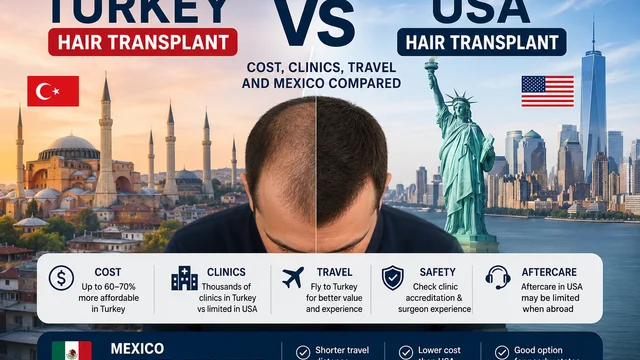
Compare hair transplant in Turkey vs the USA by cost, clinic model, travel, aftercare, safety checks and Mexico as an alternative. Learn when Turkey makes sense, when staying in the US may be better, and what American patients should verify before booking.
Turkey vs USA Hair Transplant: Cost, Clinics, Travel and Mexico Compared
For many American patients, the hair transplant decision is no longer only about FUE vs DHI or how many grafts they need. It often becomes a three-way comparison:
Stay in the United States
Travel to Mexico
Fly to Turkey
The USA offers local consultation, easier in-person follow-up and well-known surgeon-led clinics. Mexico offers shorter travel for North American patients. Turkey offers a larger medical tourism market, package-based pricing, hotel-transfer models and a wide range of clinics used to treating international patients.
The right choice is not simply the cheapest country. The right choice depends on your donor area, hair loss stage, budget, travel tolerance, aftercare needs and how carefully you compare clinics.
This guide compares Turkey vs the USA for hair transplant surgery, with Mexico included as a practical alternative for American patients.
Why American patients consider Turkey
American patients usually start researching Turkey for one reason: the price gap.
A 2,500–4,000 graft case in the United States can become expensive quickly when pricing is calculated per graft. In Turkey, many clinics advertise full packages instead of pure per-graft pricing. These packages may include the operation, hotel stay, airport transfers, interpreter support, medication kits and first wash.
That package model can be attractive for American patients who want a clearer total price before travelling. But it also creates a risk: patients may focus too much on the package and not enough on the medical details.
A hair transplant is still surgery. The most important questions are not “Is the hotel included?” or “How many grafts can I get?” The most important questions are:
Who designs the hairline?
Who extracts the grafts?
Who opens the channels?
Who implants the grafts?
How many patients does the team operate on per day?
Is the donor area being protected?
What happens if complications appear after returning to the USA?
Turkey can offer strong value, but only if the clinic is medically responsible and transparent.
Hair transplant cost in the USA
The United States is usually one of the more expensive countries for hair transplant surgery.
US clinics often price based on:
graft number
FUE vs FUT
surgeon reputation
location
case complexity
crown involvement
repair work
consultation and follow-up structure
whether additional treatments are included
A small hairline case may cost far less than a large frontal and crown restoration. A surgeon-led, low-volume clinic in a major city may also cost much more than a chain clinic or a smaller regional provider.
CareCredit’s published consumer guide gives a US national average range of $4,637 to $12,513. IAHRS describes North American doctor-only FUE pricing as often ranging from $5 to $10 per graft, with an average around $7–$8 per graft. (CareCredit)
What this means in practice
A 2,000 graft case at $7 per graft can reach around $14,000 before extra costs. A 3,000 graft case can be significantly higher. Not every clinic prices this way, and not every patient needs that many grafts, but the per-graft model explains why many US patients start comparing Turkey and Mexico.
USA cost advantages
The USA can still be worth it for some patients because the price may include:
local consultation
easier follow-up
direct surgeon access
less travel risk
easier revision discussion
more accountability if problems happen
A higher price is not automatically bad if it comes with stronger medical planning and follow-up. But patients should not assume that a high quote automatically means a better result.
Hair transplant cost in Turkey
Turkey is usually cheaper than the USA because of lower operating costs, intense clinic competition, high patient volume and the package model used by many medical tourism providers.
On TransplantHair, Turkey package ranges can be compared by destination. The cost calculator explains that listed all-inclusive FUE and DHI packages in Istanbul, Antalya and Ankara often fall around €2,000–€5,500, depending on graft count, hotel tier and clinic reputation. (TransplantHair)
What Turkey packages may include
A Turkey hair transplant package may include:
online consultation
graft estimate
blood test
surgery
hotel stay
airport transfer
clinic transfer
translator support
post-op medication kit
first wash
remote follow-up
But inclusions vary. Patients should never assume that every package includes the same things.
Questions to ask about Turkey pricing
Before booking a Turkey clinic, ask:
Is the price fixed or can it change after arrival?
Is the hotel included?
How many nights are included?
Are airport transfers included?
Are medications included?
Is PRP included or extra?
What happens if fewer grafts are medically safe?
Who performs each step of the surgery?
Is the clinic or provider authorised for international health tourism?
What aftercare is provided after I return to the USA?
Turkey’s Health Tourism Department publishes official lists of healthcare providers authorised by the Ministry for international health tourism, which can be used as one verification step. (shgmturizmdb.saglik.gov.tr)
Mexico vs Turkey for American patients
For US patients, Mexico is the natural third option.
Mexico is much closer than Turkey. A patient from California, Texas, Arizona or Florida may be able to reach a Mexican clinic much faster than they can reach Istanbul. That shorter travel time can be attractive, especially for patients worried about long flights after surgery.
Marketplace data from Bookimed lists Mexico hair transplant procedures around $3,000–$4,100, while noting that prices depend on clinic and treatment plan. (Bookimed)
Mexico may make sense if:
you want lower pricing than the USA
you want shorter travel than Turkey
you live close to the border or a direct flight route
you can verify the surgeon and clinic carefully
you have a clear aftercare plan after returning home
Turkey may make more sense if:
you want a larger clinic market to compare
you want all-inclusive package competition
you are comfortable with long-haul travel
you want to compare Istanbul, Antalya, Ankara or Izmir
you are willing to spend more time researching clinics
USA may make more sense if:
you want in-person follow-up
you prefer local accountability
you have a complex repair case
you are anxious about travelling after surgery
you are willing to pay more for local care
The choice between Mexico and Turkey is not only about cost. It is about travel distance, clinic quality, aftercare and how much uncertainty you are willing to accept.
Travel from the USA to Turkey
For American patients, Turkey requires more planning than Mexico or a local US clinic.
According to the US State Department, US tourist passport holders do not need a visa for Turkey for visits of 90 days or less, but passports must have at least six months of validity beyond the entry date and at least one blank page. (Seyahat Bilgileri) Turkey’s Ministry of Foreign Affairs also states that official and ordinary US passport holders are exempt from visa requirements for touristic and transit travel up to 90 days within six months. (Dışişleri Bakanlığı)
A typical US-to-Turkey hair transplant trip may take 4–6 days:
DayTypical planDay 1Flight arrival, airport transfer, hotel check-inDay 2Consultation, blood test, hairline design, surgeryDay 3Rest or first washDay 4Post-op checkDay 5Return flight or extra recovery dayDay 6+Recovery at home in the USA
Some patients try to make the trip as short as possible. That can work logistically, but it is not always ideal medically. The first days after surgery are when swelling, scabbing, discomfort and graft-care instructions matter most.
Medical tourism risks Americans should understand
The CDC advises patients travelling for medical care to arrange follow-up care before they travel and make sure they can access any needed care after returning to the United States. (Hastalık Kontrol ve Önleme Merkezleri) CDC Yellow Book guidance also notes that local follow-up care should be coordinated before travel and that continuity of care should be arranged when patients return from medical care outside the United States. (Hastalık Kontrol ve Önleme Merkezleri)
Long flights after surgery should also be considered. CDC Yellow Book guidance notes that air travel and surgery can independently increase the risk of blood clots, and travel after surgery may further increase that risk because patients may sit for long periods while recovering. (Ulusal Biyoteknoloji Bilgi Merkezi)
Hair transplantation is usually performed under local anaesthesia and is less invasive than many major surgeries, but travel still adds complexity. Patients should ask the clinic when it is safe to fly, how to protect the grafts on the plane and what symptoms require urgent local care after returning home.
Recovery timeline: USA, Mexico and Turkey are the same biologically
The recovery biology does not change by country.
The NHS gives a general hair transplant recovery outline: bandages may usually be removed after 2–5 days, gentle washing may be possible around day 6, transplanted hair often falls out after a few weeks, new growth usually starts around 4 months, and full results may take 10 to 18 months. (nhs.uk)
This means patients should not judge their result after two weeks or even two months. Redness, scabbing and shedding can be part of normal recovery. The real result develops slowly.
The difference is not biology. The difference is follow-up access.
If you have surgery in the USA, you can usually return to the clinic more easily. If you travel to Turkey or Mexico, aftercare may be remote or require another trip. That should be discussed before payment.
Safety and credentials: what US patients should check
In the United States, patients sometimes assume that “board-certified” automatically means board-certified in hair transplant surgery. That is more complicated.
The American Hair Loss Association explains that the American Board of Medical Specialties does not have a certification process or approved medical specialty board specifically for hair transplant surgery. (American Hair Loss Association) The American Board of Hair Restoration Surgery describes itself as a hair surgeon certification board and provides a directory of certified Diplomates, but patients should understand what any credential means and verify it independently. (abhrs.org)
This matters because hair transplant marketing can be confusing. Patients should verify:
medical licence
dermatology or surgery background
ABHRS status if claimed
ISHRS membership if claimed
who actually performs the procedure
whether technicians perform key steps
malpractice or disciplinary history where available
before-and-after cases with timeline and graft count
In Turkey, patients should check Ministry of Health international health tourism authorisation. In Mexico, patients should check doctor credentials, clinic licensing, infection control standards and aftercare access.
US hair transplant clinic examples patients often research
The following US clinics are included only as research examples. They are not ranked, verified or endorsed by TransplantHair.
Bosley
Bosley is one of the most visible national hair restoration brands in the United States. Its website describes hair transplant and restoration locations across many US states, including cities such as Beverly Hills, New York, Atlanta, Philadelphia, Seattle and Chicago. (Bosley Hair Transplant)
Bernstein Medical, New York
Bernstein Medical is a hair restoration center in New York City. Its website describes the clinic as a hair restoration facility focused on diagnosing and treating hair loss in men and women. (bernsteinmedical.com)
Shapiro Medical Group, Minnesota
Shapiro Medical Group is a Minneapolis-area hair restoration practice. Its website describes FUE, FUT and scalp micropigmentation services, and the ISHRS profile for Dr. Ron Shapiro describes him as the founder and director of Shapiro Medical Group. (shapiromedical.com)
Anderson Center for Hair, Atlanta
Anderson Center for Hair is an Atlanta-area hair transplant clinic. Its website describes surgical hair restoration services and advanced hair restoration technologies. (Anderson Center for Hair)
Again, these are not recommendations. They are examples of US providers that patients may come across when comparing local surgery with Turkey or Mexico.
Turkey clinic types American patients usually compare
Turkey has a large and varied hair transplant market. Instead of searching for one universal “best clinic”, American patients should understand the clinic type.
1. High-volume package clinics
These clinics often treat many international patients and offer competitive all-inclusive prices. They may be attractive for cost-conscious patients, but patients should ask how many surgeries happen per day and how much doctor involvement exists.
2. Surgeon-led premium clinics
These clinics usually position themselves around doctor involvement, donor management, selective patient intake and detailed planning. Prices may be higher, but the process may be more personalised.
3. Technique-focused clinics
Some clinics market DHI, Sapphire FUE, unshaven FUE, Afro hair transplant, beard transplant or crown restoration. Technique matters, but technique should never replace proper diagnosis and donor planning.
4. American-patient package clinics
Some Turkey clinics actively market to US patients with English-speaking coordinators, airport transfers, hotel packages and WhatsApp follow-up. Communication is important, but it should not replace medical transparency.
On TransplantHair, patients can compare Turkish clinics by city, pricing, rating, services and profile details before contacting providers.
Turkey vs USA: which is better?
There is no universal answer.
Turkey may be better if:
you want lower package pricing
you are comfortable with long-haul travel
you want to compare many clinics
you understand remote aftercare
you verify authorisation and doctor involvement
you are not choosing only by price
you can take enough recovery time before flying home
The USA may be better if:
you want local consultation
you want easier in-person follow-up
you have a complex repair case
you are nervous about surgery abroad
you want clearer local accountability
you are willing to pay more
you prefer a slower consultation process
Mexico may be better if:
you want lower pricing than the USA
you want shorter travel than Turkey
you can verify the clinic carefully
you live close enough for easier follow-up
you are comparing border-region or direct-flight options
The best choice is not the cheapest country. It is the clinic that gives you a realistic plan, protects your donor area and provides clear aftercare.
Red flags in Turkey, USA and Mexico
Avoid any clinic that:
guarantees perfect density
promises unlimited grafts
refuses to name the responsible doctor
cannot explain who performs each surgical step
gives a quote without clear photos or donor assessment
shows before-and-after photos without graft count or timeline
pressures you with a same-day discount
avoids discussing complications
has no written aftercare plan
treats travel logistics as more important than medical planning
The International Society of Hair Restoration Surgery warns that poor FUE practice can involve overharvesting the donor area or harvesting too widely outside the safe donor area. (ISHRS) That is one of the biggest reasons patients should be careful with “maximum grafts” marketing.
How American patients should compare quotes
Do not compare only the headline price.
A fair comparison should include:
QuestionWhy it mattersHow many grafts are planned?More grafts are not always saferWhat technique is used?FUE, FUT, DHI and Sapphire differWho performs extraction?Doctor and technician roles varyWho opens the channels?This affects angle, direction and densityIs the hairline design personalised?An unnatural hairline can be hard to fixIs the donor area protected?Overharvesting can cause permanent problemsWhat aftercare is included?Travel patients need clear remote supportAre hotel and transfers included?Package details varyWhat happens if complications occur?Especially important after returning homeIs revision policy explained?Growth takes months and outcomes vary
A $3,000 package can be expensive if the result is poor. A $12,000 procedure can also be poor value if planning is weak. The number that matters most is not the quote. It is the quality of the medical plan.
Suggested decision path for US patients
Step 1: Understand your hair loss stage
Use the Norwood scale as a starting point, but do not rely on self-diagnosis alone. Diffuse thinning, crown loss and weak donor areas require professional assessment.
Step 2: Estimate graft needs
A graft calculator can help you understand whether your case may be closer to 1,500, 3,000, 4,000 or 5,000+ grafts. But a calculator is only a planning tool. A clinic still needs to assess your donor area.
Step 3: Compare US, Mexico and Turkey quotes
Do not compare only price. Compare graft plan, doctor involvement, aftercare and travel burden.
Step 4: Ask for written aftercare details
Before paying a deposit, ask who reviews your photos, how often you should send updates and what symptoms require urgent local care.
Step 5: Use Turkey comparison tools if considering Istanbul or Antalya
If you are considering Turkey, compare multiple verified clinic profiles, package price ranges and before-after cases before contacting clinics.
Final verdict: Turkey vs USA hair transplant
Turkey can offer strong value for American patients, especially when the clinic is transparent, authorised and experienced with international patients. The package model can make pricing easier to understand and often much lower than US quotes.
The USA can be better for patients who prioritise local consultation, easier follow-up and local accountability. For complex repair cases, anxious patients or those who do not want long-haul travel, staying in the US may be worth the higher price.
Mexico sits between the two. It may offer lower prices than the USA and shorter travel than Turkey, but clinic verification and aftercare still matter.
The safest choice is not the cheapest destination. It is the clinic that protects your donor area, gives a realistic graft plan, explains the risks and supports you after surgery.
If you are considering Turkey, start by comparing verified clinics, package prices and clinic details on TransplantHair before making contact.
Medical disclaimer
This article is for educational purposes only and does not replace medical advice. Hair transplantation is a surgical procedure. Always consult a qualified medical professional before making a treatment decision.
FAQ Items
Is a hair transplant cheaper in Turkey than in the USA?
Yes, Turkey is often cheaper than the USA because many Turkish clinics use package pricing that may include surgery, hotel, transfers and post-op support. However, patients should compare the full medical plan, not only the price.
How much does a hair transplant cost in the USA?
US hair transplant costs vary widely by graft number, technique, location and surgeon involvement. Consumer cost guides commonly place US procedures in the several-thousand-dollar range, and per-graft pricing can make larger cases expensive.
Why do Americans go to Turkey for hair transplants?
Americans often consider Turkey because of lower package prices, many clinic options, international patient support, hotel-transfer packages and the large hair transplant market in Istanbul and other Turkish cities.
Is Turkey safe for American hair transplant patients?
Turkey can be safe when the clinic is authorised, transparent and medically responsible. Patients should check doctor involvement, donor area planning, clinic authorisation, before-and-after cases and aftercare before booking.
Do US citizens need a visa for Turkey?
US tourist passport holders generally do not need a visa for Turkey for visits of 90 days or less, but they should check current official entry requirements before booking travel.
Is Mexico better than Turkey for US patients?
Mexico may be better for US patients who want shorter travel and lower prices than the USA. Turkey may offer a larger clinic market and more all-inclusive package options. The better choice depends on the specific clinic, aftercare and travel comfort.
What should I ask a Turkey hair transplant clinic before booking?
Ask who performs each surgical step, how many patients are treated per day, whether the provider is authorised for international health tourism, what aftercare is included and whether your graft estimate is realistic.
Should I choose Turkey, Mexico or the USA for my hair transplant?
Choose Turkey if you want strong package value and can compare clinics carefully. Choose Mexico if shorter travel matters. Choose the USA if local follow-up and accountability are more important than price.